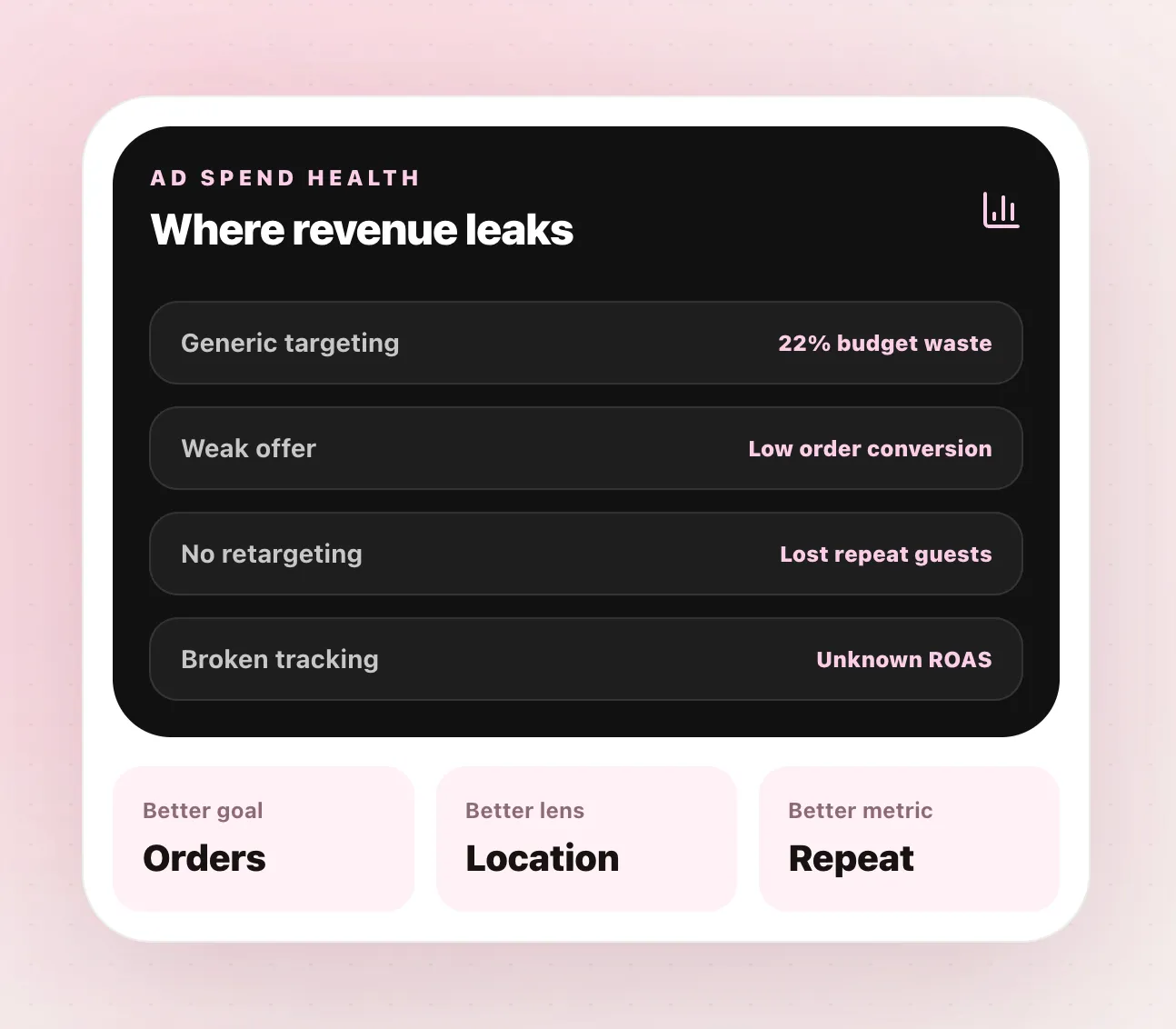
Why most restaurant advertising does not create enough sales
Many restaurant operators are not against advertising. They are against wasting money. They have tried boosted posts, Google campaigns, Instagram promotions, influencer videos, or a generic agency — but they still cannot clearly answer one simple question: did this spend bring profitable orders?
The issue is usually the strategy around the platform: the audience, offer, creative, menu path, tracking, retargeting, and follow-up system.
A restaurant ad has to do more than create awareness. It must match a real food-buying moment. A family looking for dinner, an office manager planning catering, a lapsed guest who has not ordered in two months, and a student looking for a late-night deal all need different campaigns.
Clicks are not the goal
Clicks only matter when they move people toward an order, visit, call, app install, catering inquiry, or repeat purchase.
The menu matters
Food visuals, combos, best sellers, high-margin items, and limited-time offers often decide whether the ad converts.
Location changes everything
Delivery zones, pickup behavior, branch density, and nearby competition shape the campaign.
Follow-up creates profit
Retargeting, CRM, email, SMS, WhatsApp, and loyalty turn acquisition into repeat revenue.
A better restaurant advertising strategy
Every restaurant advertising campaign should be built around five connected questions. When one of these is weak, the campaign leaks money.
Who are we trying to reach?
New guests, nearby searchers, past customers, catering buyers, app users, loyalty members, or people near a specific branch.
Why should they act now?
A clear menu item, offer, limited-time special, combo, event, loyalty reward, or practical reason to order today.
Where should we reach them?
Google for high intent, Meta for visual demand, TikTok for discovery, retargeting for recovery, and local campaigns for branch growth.
Where do they convert?
Website, app, online ordering page, phone call, reservation page, catering form, directions, or loyalty sign-up.
How do we measure success?
Orders, revenue, ROAS, CAC, AOV, repeat rate, leads, calls, store-level performance, and offer-level results.
How do we bring them back?
CRM segments, email campaigns, WhatsApp, SMS, loyalty, retargeting, win-back flows, and reorder reminders.
The best restaurant advertising channels
Not every ad channel should do the same job. A strong restaurant advertising plan uses each platform for the role it is best suited to play.
| Channel | Best use | Restaurant examples |
|---|---|---|
| Google Ads | Capture high-intent demand | Food near me, cuisine searches, catering, delivery, brand searches |
| Facebook & Instagram | Create demand visually | Menu launches, limited-time offers, combo ads, local promotions |
| TikTok | Discovery and short-form food demand | Craveable videos, creator-style ads, new item awareness |
| Retargeting | Recover interested guests | Menu viewers, cart abandoners, past visitors, lapsed customers |
| Local store campaigns | Grow specific branches | New location launch, underperforming branch, slow-day offers |
| YouTube | Build awareness and trust | Brand story, menu videos, catering, multi-location campaigns |
For many restaurants, the best answer is not one platform. It is a connected mix: Google for intent, Meta and TikTok for demand, retargeting for recovery, and CRM/email/WhatsApp for repeat orders.
Restaurant ad campaigns that solve real business problems
The best campaigns start with a business problem, not with a platform. Below are campaign types restaurants can use to grow different parts of the business.
New customer acquisition
Reach nearby people who have not ordered from you yet with strong menu visuals and first-order offers.
Direct online ordering
Move traffic to your website, app, or ordering page instead of relying only on marketplaces.
Combo and upsell campaigns
Promote bundles, sides, drinks, add-ons, and high-margin items to improve average order value.
Lunch and dinner daypart campaigns
Drive demand at the exact moments when people are deciding what to eat.
New location launch campaigns
Build opening-week awareness, trial, first-party customer data, and repeat traffic for a new branch.
Catering lead generation
Capture office lunches, events, school orders, parties, and group meal demand.
Lapsed guest win-back
Retarget past customers with timely offers and reasons to order again.
App install and reorder campaigns
Grow app installs, first app orders, app-only deals, and reorder behavior.
What restaurants should track beyond clicks and impressions
Clicks, impressions, CPC, and CPM are useful platform metrics, but they do not tell the full restaurant story. A restaurant needs to understand whether advertising is creating useful revenue and better customer behavior.
How multi-location restaurants should think about advertising
Multi-location restaurants and QSR chains need brand-level consistency and local-level relevance at the same time.
Location-level advertising matters
A campaign that works for one location may not work for another. Some branches need awareness. Some need lunch traffic. Some need delivery growth. Some need catering. Some need better reviews before ads can convert properly. That is why location-level planning matters.
Common restaurant advertising mistakes that waste budget
- Boosting posts without a clear conversion goal
- Using generic creative
- Sending paid traffic to a weak ordering page
- Not separating new guests and returning guests
- Ignoring dayparts
- Not connecting ads with CRM
Restaurant advertising checklist before you spend more money
Want us to review your restaurant ad strategy?
tossdown helps restaurants run smarter Google, Meta, TikTok, retargeting, and local campaigns built around orders, visits, revenue, and repeat customers.
Restaurant advertising FAQ
What is restaurant advertising?
Restaurant advertising is the use of paid and digital channels to bring more guests, online orders, reservations, catering leads, app installs, store visits, and repeat customers to a restaurant.
Do Google Ads work for restaurants?
Yes, Google Ads can work well for restaurants because they capture people with high intent.
Do Facebook and Instagram ads work for restaurants?
Yes, especially when the ad has strong food visuals, a clear offer, local targeting, and a simple ordering path.
What should restaurants track in advertising?
Restaurants should track orders, revenue, cost per acquisition, ROAS, average order value, repeat order rate, calls, catering leads, app installs, and store-level performance.