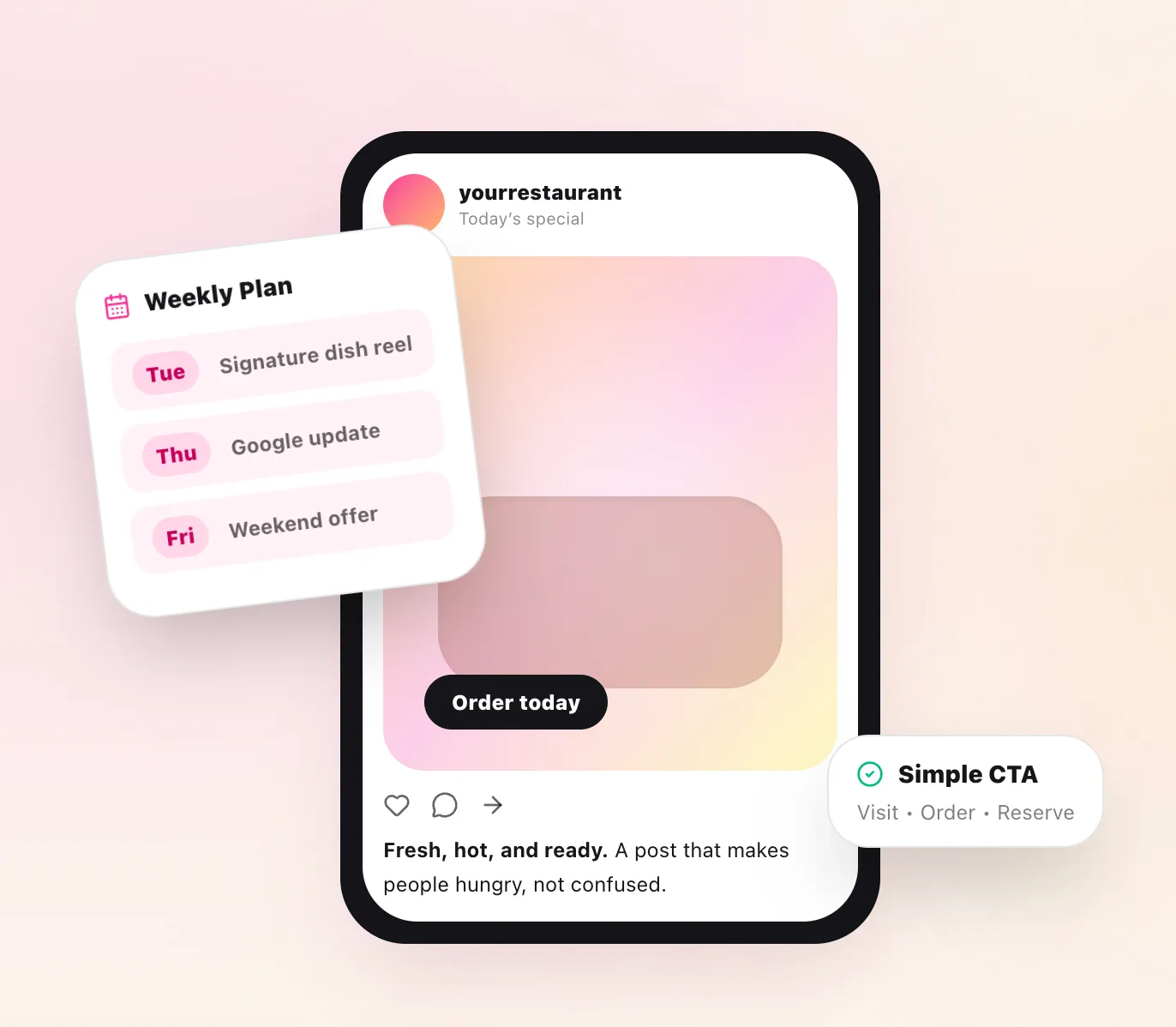
What is restaurant social media marketing?
Restaurant social media marketing is the use of platforms like Instagram, Facebook, TikTok, Google Business Profile, and sometimes LinkedIn to keep a restaurant visible, promote food, share offers, build trust, and encourage guests to order, visit, reserve, or come back.
For restaurants, social media is not just about likes. It should help answer simple business questions: Are people seeing our food? Do they know what is new? Do they remember us when they are hungry? Do they know how to order, book, or visit?
Be seen
Stay visible where guests spend time.
Look craveable
Make food and offers easy to want.
Drive action
Guide people to order, visit, reserve, or inquire.
Why social media is hard for restaurant owners
Restaurant owners are not lazy about social media. They are busy. The restaurant business already has enough moving parts: staffing, inventory, food quality, service, delivery, reviews, vendors, and daily operations.
The common issue is not knowing that social media matters. The issue is keeping it consistent, making the food look good, knowing what to post, and connecting content to real restaurant goals.
No time to post
Owners and managers are already handling staff, food costs, customers, delivery, vendors, and operations.
Posting is inconsistent
Restaurants post when someone remembers instead of following a simple weekly rhythm.
Food does not look good online
The food may be great in person, but flat photos and weak videos fail to create appetite.
No clear strategy
Content is often random: a flyer today, a menu photo next week, then silence.
Hard to track impact
Views and likes are nice, but restaurants want visits, orders, reservations, catering leads, and repeat guests.
Multiple locations get messy
QSRs, franchises, and groups need brand consistency while still sounding local.
A restaurant social media strategy does not need to be complicated
A good restaurant social media strategy is simple: show the food, show the people, show the experience, promote the right offers, and make the next step clear.
Instead of asking, “What should we post today?” ask: What do we want guests to remember, crave, and do this week?
Simple restaurant social media strategy
| Goal | Content to create | Best next action |
|---|---|---|
| More lunch orders | Lunch combo photos, quick reels, weekday stories | Order online or visit today |
| More reservations | Atmosphere, tables, chef dishes, occasion content | Reserve a table |
| More catering | Trays, event setups, office lunch examples | Request catering |
| More repeat visits | Loyalty reminders, limited-time offers, guest appreciation | Come back this week |
| More local visibility | Community posts, GBP updates, nearby events | Find us nearby |
What should restaurants post on social media?
The best restaurant content is usually simple. People want to see the food, the experience, the people behind the restaurant, and the reason to visit now.
Signature dish
Show one dish clearly with close-up video, texture, sauce, portion, and a simple order CTA.
Behind the scenes
Show prep, cooking, plating, staff moments, and the care that goes into the food.
Slow-day offer
Promote a weekday lunch, family bundle, happy hour, dessert deal, or limited-time combo.
Customer moment
Share guest photos, tagged posts, reviews, celebrations, and real dining moments.
New menu item
Build a short launch sequence: teaser, reveal, taste-test reel, story reminder, and Google post.
Catering or events
Show trays, parties, office lunches, private events, and inquiry options.
Location content
For multi-location brands, highlight branch teams, local offers, nearby landmarks, and community moments.
Seasonal campaign
Use holidays, weather, sports, school seasons, festivals, and local events to make content timely.
A simple weekly content plan restaurants can actually follow
Consistency matters more than complexity. A restaurant does not need a new viral idea every day. It needs a repeatable rhythm that keeps the brand active and useful.
Weekly posting rhythm
| Day | Focus | Details |
|---|---|---|
| Monday | Plan | Review the week: offers, menu focus, local events, slow days, and content gaps. |
| Tuesday | Food post | Highlight one product with a simple caption and CTA. |
| Wednesday | Reel or story | Post a short video: prep, staff, behind-the-scenes, or a dish in motion. |
| Thursday | Local/GBP update | Share a Google Business Profile update, event, special, or weekend reminder. |
| Friday | Weekend push | Promote reservations, family meals, catering, dessert, or limited-time offers. |
| Weekend | Real moments | Capture guests, atmosphere, kitchen moments, UGC, and stories. |
Different restaurant models need different social content
A QSR, café, fine dining restaurant, franchise, and food brand should not all post the same way. The best content reflects how guests discover, choose, and buy from that type of business.
Your food has to look good enough to stop the scroll
Restaurant content is visual first. If the food looks cold, flat, dark, dry, or confusing, people keep scrolling. Good food content should make the dish easy to understand and easy to want.
That does not mean every post needs a professional shoot. Restaurants can use a smart mix of creator content, team-shot videos, guest content, designed posts, menu photography, and carefully produced AI-enhanced visuals. The key is quality control and taste.
Make the dish clear
Show what it is, how big it is, and why it is worth ordering.
Use motion
Steam, sauce pulls, pouring, slicing, boxing, and plating make food feel alive.
Keep it realistic
Food content should look beautiful without feeling fake or over-edited.
Where should restaurants post?
Most restaurants do not need to be everywhere with equal effort. They need to be strong where guests discover food, check credibility, look for updates, and decide what to do next.
| Platform | Best for | Content to post |
|---|---|---|
| Food discovery and brand feel | Reels, stories, carousels, menu items, creator content | |
| TikTok | Short-form discovery | Food videos, behind-the-scenes, trends used carefully |
| Local community and events | Offers, updates, events, family promos, local posts | |
| Google Business Profile | Local search visibility | Offers, menu updates, photos, events, weekly specials |
| Food brands and catering | Corporate catering, partnerships, openings, milestones |
What should restaurants track beyond likes?
Likes are easy to see, but they do not tell the whole story. A restaurant should also look at signals that show attention, intent, and action.
Visibility
Reach, impressions, profile views, follower growth, Google views.
Engagement
Saves, shares, comments, DMs, tagged posts, story replies.
Intent
Website clicks, order link clicks, reservation clicks, calls, direction requests.
Business signals
Offer redemptions, catering inquiries, event bookings, repeat campaigns, location-level movement.
Restaurant social media mistakes to avoid
- Only posting flyers: Social posts should feel like food, people, and experience — not just ads.
- Posting without a goal: Every week should have a focus: visibility, offer, reservation, catering, menu launch, or repeat visit.
- Ignoring Google Business Profile: Local updates matter when guests are searching nearby.
- Using the same content for every location: Multi-location brands need both brand consistency and local relevance.
- Chasing trends without a restaurant reason: Trends should support the brand, not distract from it.
- Not replying to comments and DMs: Social media is not only publishing. It is also conversation.
Want social media handled for you?
tossdown manages restaurant social media from strategy and calendar planning to creative, publishing, community workflows, reporting, creators, and influencer add-ons.
Restaurant social media marketing FAQ
How often should a restaurant post on social media?
Most restaurants should aim for a consistent rhythm rather than random bursts. A practical starting point is a few strong posts per week, regular stories, and timely Google Business Profile updates. Multi-location brands may need location-specific content calendars.
Which social media platforms matter most for restaurants?
Instagram and TikTok are strong for discovery and food visuals. Facebook still matters for local communities, families, events, and promotions. Google Business Profile is important for local search visibility. LinkedIn can help food brands, catering, and B2B hospitality businesses.
What should restaurants post on social media?
Restaurants should post food visuals, reels, behind-the-scenes content, staff moments, offers, new menu items, catering content, events, reviews, user-generated content, and local community updates.
Do restaurants need professional photos and videos?
Not every post needs a large shoot, but restaurants do need food to look appealing. A mix of professional assets, creator footage, owner/team videos, user-generated content, and well-designed posts usually works best.
Should restaurants use influencers?
Influencers can help when there is a clear goal, good creator fit, strong food presentation, and a plan for what happens after the post. For many restaurants, local micro-creators are more useful than big generic influencers.
How do you know if restaurant social media is working?
Look beyond likes. Track consistency, reach, saves, shares, profile visits, website clicks, direction requests, calls, reservations, direct ordering traffic, catering inquiries, and offer redemptions.